Last Updated:
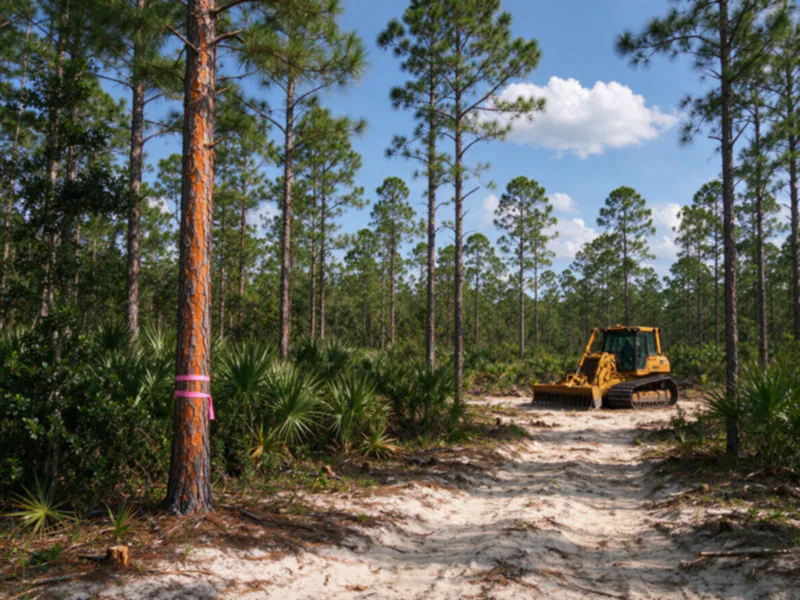
You don’t always want a bare lot. Maybe there’s a live oak that will shade the house for decades, or a row of pines that screens the neighbors. Sunward Palm Coast Land Clearing does selective clearing across Palm Coast and Flagler County: on new home lots, in established yards that have closed in, and on acreage being thinned under its pines.
We take out the brush, vines and unwanted trees and leave the ones worth keeping. It’s slower than clearing everything, because the machine has to stay away from the trees that stay, and that’s the point. A tree only survives clearing if its roots do.
Which trees can you keep, and which need a permit?
In Palm Coast, any tree with a trunk of 6 inches or more at 4.5 feet needs a tree removal permit, or 4 inches and up if it’s surveyed for credit. Permits go through the city’s Urban Forestry office, and replacement trees may be required. If you pay into the city’s tree bank instead of planting, the fee schedule sets $220 for a 2-inch shade tree or 1.5-inch understory tree, $275 for a sabal palm and $580 for a 3.5-inch shade tree.
The city’s permit checklist for a new single-family home also calls for one tree for every 2,500 square feet of lot, four on a 10,000-square-foot lot, and on a new home lot the survey has to show every tree of 6 inches and up as kept or removed. So your keep list is a planning decision with costs on both sides, and we settle it on paper before anything is cut. Our tree removal permit guide covers the process.
Outside the city the rules change. Bunnell counts index trees such as oaks, maples and cypress per 2,500 square feet, and pines aren’t on its list, so in Bunnell your oaks carry the weight of the decision.
How we choose the keepers with you
We walk the lot with your survey and look at each candidate. A good keeper is healthy, a long-lived species and far enough from construction that its roots survive. Live oaks and pines set back toward the lot edges usually make it. A tree within a few feet of the foundation rarely does, because the footing and the grubbing for the slab cut most of its roots on that side. Laurel oaks, which are shorter-lived, and trees leaning toward the house need a harder look.
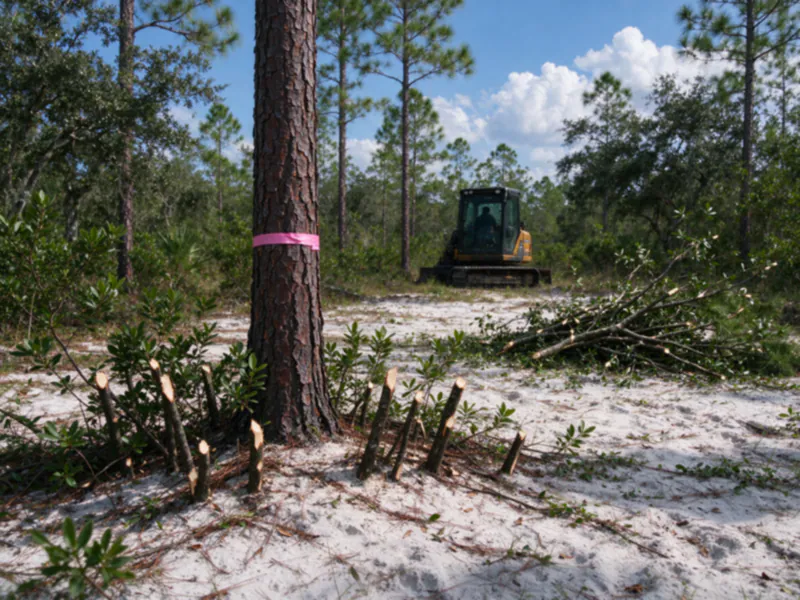
We flag each keeper on the ground and list the trees coming out, with trunk sizes, for the permit. We also plan the access so the machine reaches the work without driving through a root zone.
Tree removal permits are issued only to the owner or an agent with written authorization, and Urban Forestry’s inspectors aim to call within a week of a request, so we get the keep list and permit request in well ahead of the clearing date.
Trees you want to keep?
Mark them on the survey or send us photos, and we'll write the scope around them.
How we protect them
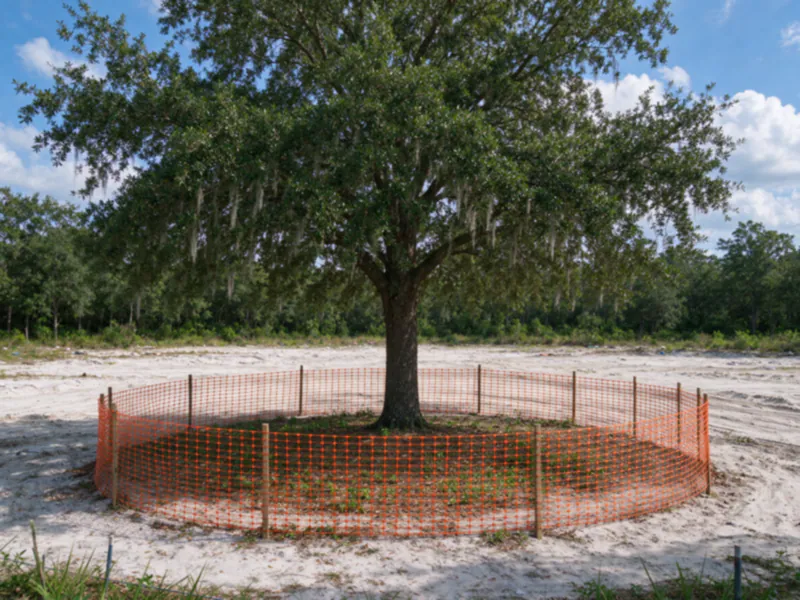
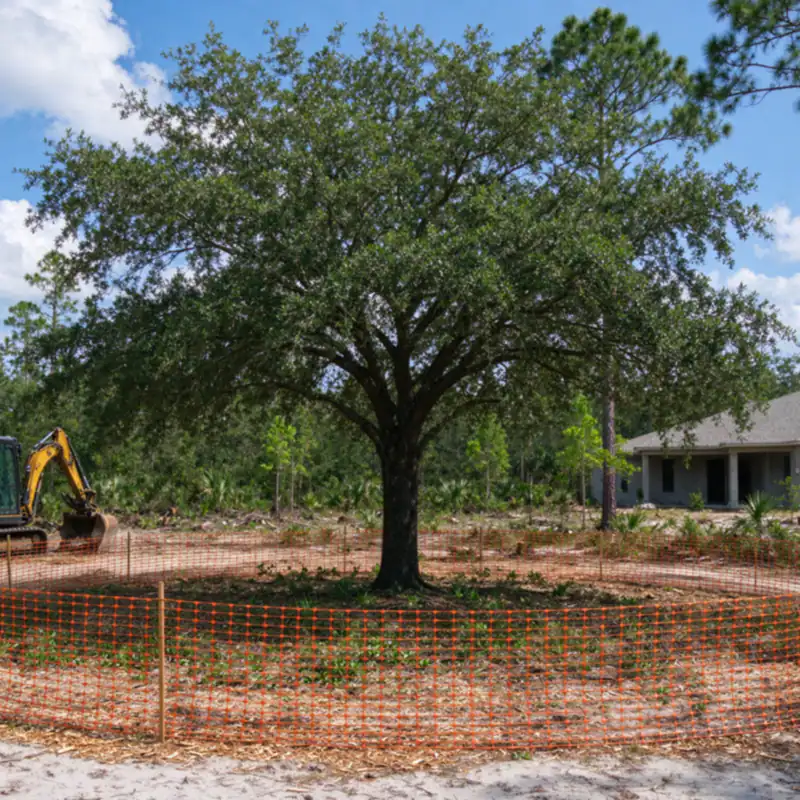
Most of a tree’s roots sit in the top foot of soil and spread past the edge of its branches. Tracks compact that soil and blades scrape it, and the damage often shows only after a few seasons. So we put the protection fence at the drip line or beyond before any machine arrives, and nothing goes inside it: no tracks, no debris piles, no fill, no parked trucks.
Inside the fence we work with saws and by hand. We cut brush and saplings and carry them out instead of mulching in place, and we grind the stumps of removed trees near a keeper instead of pulling them, so its roots don’t come out with them.
Thinning acreage or opening a yard
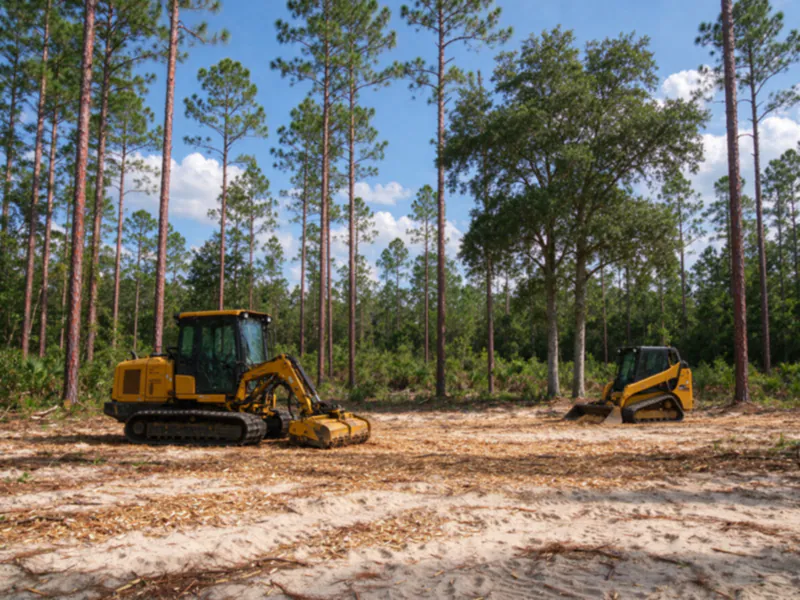
On acreage we thin a stand instead of flattening it: palmetto and hardwood brush cleared under the pines, trails and sight lines opened, firebreaks cut. A forestry mulcher does most of it, kept outside the drip lines of the trees that stay. In an established yard it usually means taking the back of the lot back to the fence while the canopy stays, which overlaps with brush clearing.
Worried about a dangerous tree?
Sometimes the tree in question isn’t one you want to keep but one you’re afraid of: a leaning pine over the roof, a hollow oak by the driveway. On a residential lot with a home on it, Florida Statute 163.045 says a local government can’t require a permit, fee or mitigation to remove a tree when you have documentation from an ISA certified arborist or a Florida licensed landscape architect that it poses an unacceptable risk. It doesn’t apply to a vacant lot being cleared to build, where the normal permit applies.
Watch the grading around your keepers
Clearing is only half the risk to a kept tree; the grading that follows can bury or cut its roots too. Palm Coast lots usually have to drain from the rear to the front swale (see what to do after land clearing), and piling fill around a trunk smothers the roots near the surface as surely as scraping them away. If a keeper sits where your builder’s grading plan changes the ground level, raise it with the builder and engineer before we clear, while you can still swap it for another tree on the list.
Keeping palms
Sabal palms are common on Palm Coast lots, and the city’s fee schedule treats them separately, at $275 for one paid into the tree bank. Palms have a compact root ball, not spreading roots, so a kept palm needs less room than an oak, and a removed one grinds out quickly.
What it costs
Selective clearing takes more time than clearing everything, mostly in hand work and moving around keepers, so it sits higher within our land clearing cost ranges for the same density. We price it from the walk, with the keeper count and the hand work listed in your estimate. On the other side of the ledger, every tree you keep can mean one fewer replacement to plant or pay for, and less debris to haul.
What we do on a selective clearing job
- Keepers chosen against the survey and flagged on the ground
- Protection fence at or beyond each keeper's drip line
- Trees for removal listed for the tree permit with trunk sizes
- Brush, vines and unwanted trees cleared around the keepers
- Saw and hand work inside the drip lines instead of machines
- No fill, debris piles or vehicle traffic inside the fences
- Debris mulched outside the root zones or hauled
Choosing which trees to keep
| Usually worth keeping | Weigh carefully | Usually removed | |
|---|---|---|---|
| Position | Set back from the footprint, at lot edges and corners | Close to the house | Inside the slab, driveway or utility runs |
| Species | Live oak, healthy pines | Laurel oak, water oak | Trees already in decline |
| Condition | Sound trunk, full crown | Leaning toward the house | Hollow, split or dead |