Last Updated:
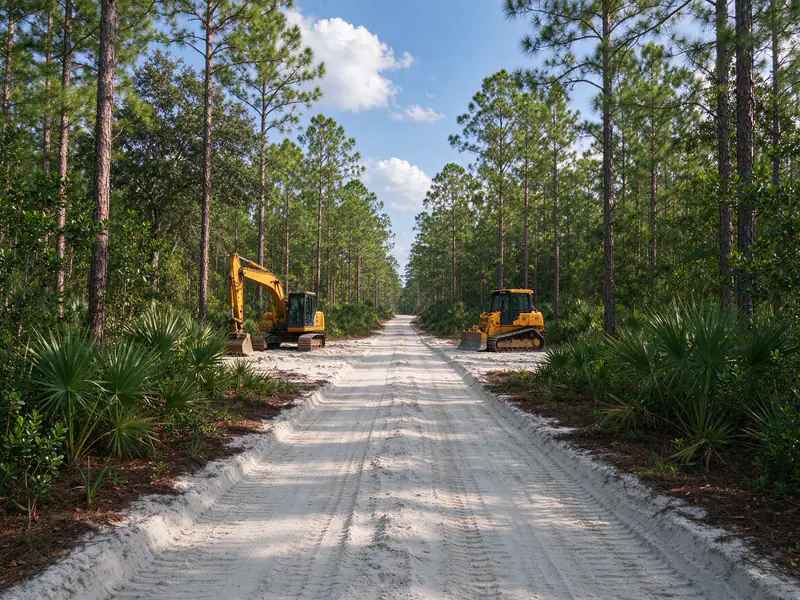
West and south of Palm Coast the land opens up into bigger parcels: homesites of an acre or two around Daytona North and Espanola, wooded tracts around Bunnell, and acreage along the county roads. Sunward Palm Coast Land Clearing clears acreage across Flagler County, and on these parcels you rarely need the whole thing opened. Usually it’s a homesite, a driveway, a septic area, a fence line or a firebreak, with the rest left as woods.
That’s good news for your budget. Every acre you leave wooded is an acre you don’t pay to strip, haul or stabilize. Vacant residential parcels across the Bunnell postal area, which takes in Daytona North and Espanola, average about 1.76 acres, and where a parcel runs on a well and septic, we plan the clear around both.
Who controls clearing out here?
Most of this land is unincorporated, so Flagler County, not a city, decides. The county allows land clearing through the building or development permit, after a site plan or plat approval, a building permit application, or for an occupied property, and the application carries a tree survey less than 24 months old. Farm work, including timber harvest under the state’s silviculture best management practices, is exempt, and so is firewise clearing to Florida Forest Service standards. Our unincorporated Flagler County page covers the details, and our Bunnell page covers the city’s own permit.
What we look at on the walk
We walk your lines and the planned layout: where the house sits, the driveway route from the road, the well and septic or the planned drain field, and any outbuildings. We flag the keepers and the stands you want left. Gopher tortoises dig in the drier sand ridges that often make the best homesites, and work within 25 feet of a burrow needs an FWC permit first, so we look before any machine does.
We pay close attention to water. Soil samples near Espanola and Bunnell find Myakka and Pomona fine sands with the wet-season water table within about a foot of the surface, and low spots that hold water may be wetlands, where clearing or filling can need a state permit. Our wetlands guide explains who decides.
Planning a homesite?
Send the parcel number and a rough sketch of what you want opened. An aerial screenshot is fine.
Where you put the house changes the tree bill
Flagler County’s tree ordinance, for permits submitted from September 18, 2024, counts index trees from 6 inches, with specimen trees at 18 inches and historic trees at 36. On a single-family site you keep or replace half of the tree inches that were there before development, but trees in or right beside the house footprint are exempt from replacement, and you can pay into a tree bank instead of planting. So on acreage, siting the house in a clearing or a pine stand instead of among big oaks keeps the replacement bill down. We’ll point out the cheaper spots on the walk, before you settle the house plan.
One method for each part of the parcel
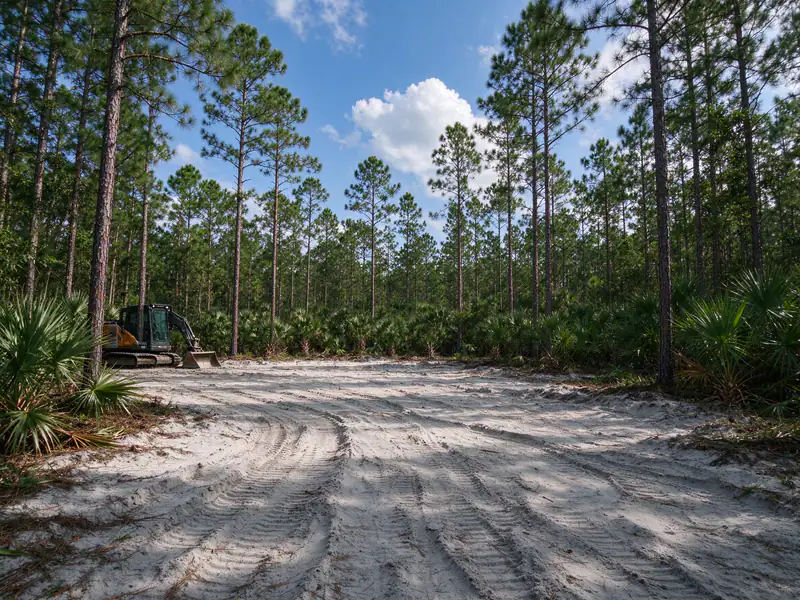
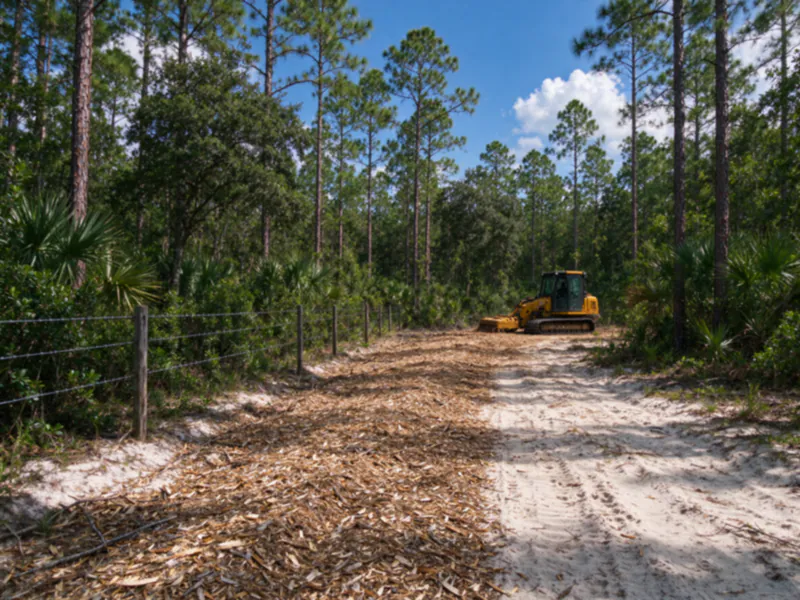
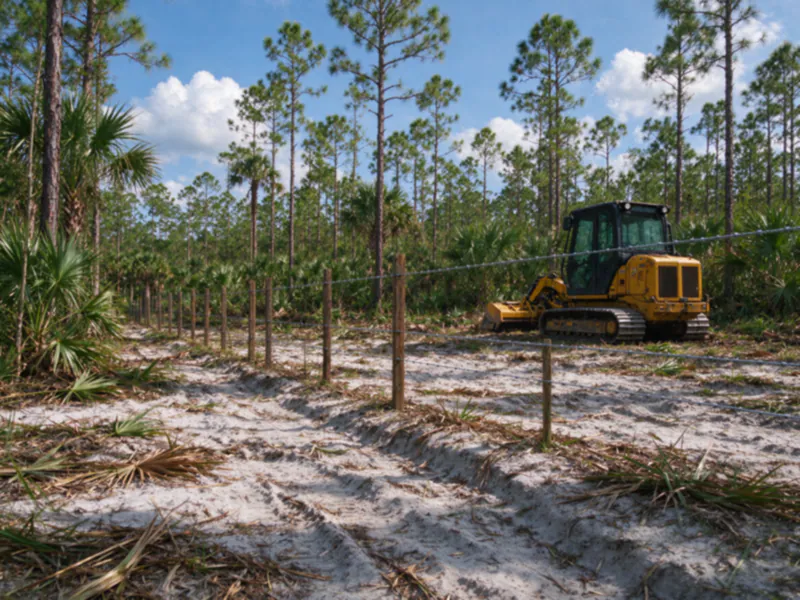
We use a mix, each where it fits. The homesite, garage and driveway we clear and grub to clean sand, because buried roots under a slab or a driveway cause trouble later. The septic area we clear to the installer’s layout. Around that, a forestry mulcher opens a yard, trails, fence lines and firebreaks, grinding palmetto and brush in place and leaving the pines. Stands you’re keeping as woods we can thin under the canopy with selective clearing. Mixing methods keeps your cost and haul-off down and leaves as little bare sand as possible.
On a well and septic?
We keep machines, fuel and debris piles well clear of the well head and plan the route in so loaded trucks don’t cross it. We flag an existing septic tank and drain field and stay off them, because tracks over a drain field crush the lines and compact the soil it depends on. For a new system we clear to the installer’s layout and pull the stumps and roots where the drain field goes, so the lines sit in clean sand. The septic permit sets the distances between the well, the septic system and the house, so that layout comes before our clearing plan, not after.
When is the ground dry enough?
About half of the area’s 51.44 inches of yearly rain falls from June through September. On wet flatwoods sand a loaded machine ruts and stalls, an unpaved road may not carry a truck, and open ground washes. The dry months are easier on everything; in summer we plan around the forecast, as our rainy season guide explains.
Cutting the fire fuel around your home
On a wooded parcel the fire risk is the brush around the house, not the trees. We mulch palmetto, gallberry and wax myrtle back from the house and outbuildings and cut a mulched firebreak along the parcel’s edge, which takes away the fuel a ground fire would use to reach them. The brush grows back, so plan on repeating it every few years. Our brush clearing page covers the cutting.
Can you burn the debris on acreage?
Sometimes, where you never could on a platted lot. Florida keeps residential pile burns 300 feet from occupied buildings other than yours, 100 feet from paved public roads and 50 feet from brush, with authorization through the Florida Forest Service, and Flagler County’s drought burn bans still apply. Our burning guide covers the rules. Most of our plans keep mulching or hauling as the fallback.
What it costs
Our typical ranges run $1,200 to $2,500 per acre for light clearing, $2,500 to $4,500 for moderate growth and $4,500 to $8,000 for heavy woods. On acreage your price follows the area we actually clear and how we clear it: a mulched trail costs far less per acre than a grubbed homesite. A parcel cleared in stages is fine too: you can open the driveway and homesite now and the yard or fence lines later, though each visit carries the cost of moving the machines in. Our cost guide has the full breakdown.
What we do on acreage
- Parcel walk: lines, homesite, driveway route, well and septic areas, wet ground
- Keepers and stands to leave flagged
- Homesite and driveway cleared and grubbed
- Septic and drain field area cleared to the installer's layout
- Fence lines, trails and firebreaks mulched
- Debris mulched, hauled or, where allowed, pile-burned under authorization
- Silt fence where bare ground drains toward a road or neighbor
Our typical per-acre ranges by density
| Light | Moderate | Heavy | |
|---|---|---|---|
| Range | $1,200 to $2,500 per acre | $2,500 to $4,500 per acre | $4,500 to $8,000 per acre |
| Looks like | Scattered trees, thin brush | Pine and palmetto, continuous understory | Closed canopy, dense palmetto, many stumps |
Our typical ranges, not quotes. Mulching only, or grubbing only where needed, changes where a parcel lands.