Homesites and larger parcels
Acreage clearing
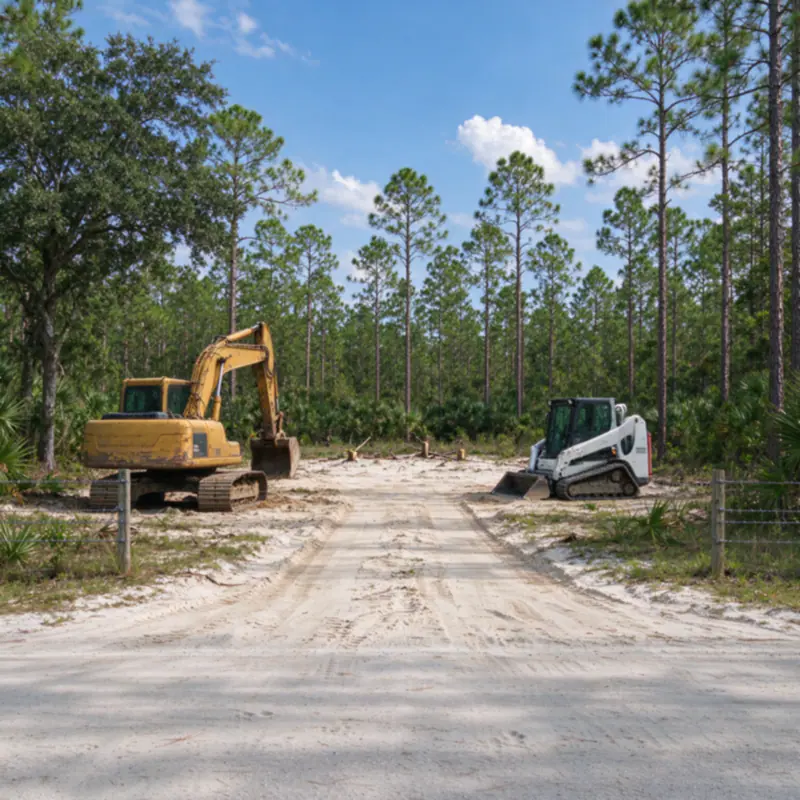
Homesites, trails, fence lines and fire breaks on the larger parcels west and south of Palm Coast, worked around wells, septic and wet ground.
Unincorporated Flagler County
Own land out in Daytona North, Espanola, St. Johns Park or the Hammock? We clear homesites, driveways and acreage under the county's own rules, and we help you site the house so fewer trees need replacing.
What changes a clearing job in Flagler County
Start with the land
House pad, driveway and septic area cleared and grubbed; trails and the rest of the parcel mulched or left wooded.
Acreage clearingFirewise clearing done to Florida Forest Service standards is exempt from the county's clearing rules.
Brush clearingSpecimen trees start at 18 inches and historic trees at 36 inches, so siting the house matters.
Selective clearingMyakka sand near Espanola holds the wet-season water table within about a foot of the surface.
Clearing in the rainy seasonServices
Homesites and larger parcels
Homesites, trails, fence lines and fire breaks on the larger parcels west and south of Palm Coast, worked around wells, septic and wet ground.
After the house permit
A platted lot opened for the slab, driveway and utilities once the home permit is issued, with the keepers marked, silt fence up and the swale left clean.
Brush ground in place
Palmetto, brush and small trees ground where they stand into a mulch layer. Roots stay in the ground, so it suits yards, buffers and acreage, not a slab.
Roots out under the slab
Clearing takes what is above ground. Grubbing pulls the stumps, roots and buried organics out of the house footprint so the pad starts on clean sand.
Keeping the good trees
Brush and unwanted trees out around the oaks and pines you are keeping, with the keepers flagged before any machine arrives and the permit list in order.
Palmetto and underbrush
Saw palmetto, gallberry, wax myrtle and vines cut back to ground level, including the brush Palm Coast treats as a fire hazard beside a home.
How the work runs
We confirm your parcel is unincorporated; the building or development permit is what opens the door to clearing.
We total the survey's tree inches so you know the 50% keep-or-replant figure, with the footprint trees set aside as exempt.
Grubbing under the house and driveway, mulching for yard, trails and firebreaks, timed around wet ground.
We mulch or haul the wood, burn only where setbacks, authorization and burn bans allow, then walk the parcel with you.
Last Updated:
Outside the city limits of Palm Coast, Bunnell, Flagler Beach, Beverly Beach and Marineland, Flagler County itself controls land clearing. That covers Daytona North, Espanola, St. Johns Park, Korona and the Hammock, and the rural land between them, and it’s busy country: the Census Bureau counted 410 single-family homes permitted in unincorporated Flagler County in the latest full year, after a peak of 618 four years earlier. Sunward Palm Coast Land Clearing clears homesites and acreage across it, and the county’s rules shape every job we do there.
Clearing in the county is tied to a permit. The county’s code allows land clearing through the building or development permit, after a site plan or plat approval, a building permit application, or for an occupied property, and the application carries a tree survey less than 24 months old. Farm work, including timber harvest under the state’s silviculture best management practices, is exempt, and so is firewise clearing done to Florida Forest Service standards, which the code treats as emergency work. Maintenance along roadsides and under power lines is exempt too.
The tree rules are where planning saves you money. The county’s compliance form, effective September 18, 2024, requires each single-family lot to keep or replant at least 50% of the total tree inches on the site before development, up from 40%, and the same figure applies along the Scenic A1A corridor. Index trees start at 6 inches, specimen trees at 18 and historic trees at 36. Trees in or right beside the proposed house footprint are exempt from replacement, and you can pay into a tree bank fund instead of planting. On a parcel of an acre or two, that makes your house site a tree decision: we’ll show you how placing it in a pine stand or an opening, not among big oaks, keeps the replacement count low, and selective clearing around the oaks that stay makes up the rest.
The land is mostly flatwoods. A soil sample near Espanola finds Myakka fine sands, poorly drained, with the wet-season water table only six inches to a foot down, so in summer we plan around the rain, as our rainy season guide explains. Low, ponded ground may be wetland, where an environmental resource permit can apply; our wetlands guide covers who decides. Federally listed species have shaped clearing here before, including a habitat conservation plan for the Florida scrub-jay and eastern indigo snake on a coastal development, and gopher tortoises dig in the drier ridges, where work within 25 feet of a burrow needs an FWC permit.
Not to the curb. Flagler County’s guidelines for unincorporated areas say contractor-generated yard waste, such as land clearing, isn’t collected by the curbside hauler unless you arrange and pay for it directly. So we build the debris plan into your scope: mulched in place with a forestry mulcher, hauled to a facility that takes it, or on bigger parcels burned where Florida’s setbacks can be met and the Forest Service authorizes it, outside drought burn bans. Our burning guide and acreage clearing page cover both.
Why the order matters
Every tree inch you keep is one fewer to replace, less to haul and less bare sand on wet ground.
Footprint trees are exempt from replacement, so a house sited in a pine stand instead of among oaks costs you less.
Firewise work to Forest Service standards is exempt and worth repeating as the brush grows back.
Places, routes and the permit office
Flagler County Central Permitting: clearing is authorized through the building or development permit, with a tree survey less than 24 months old.
Each single-family lot must preserve or replant at least 50% of the total pre-development caliper inches on the site. Trees in or immediately beside the proposed house footprint are exempt from replacement, and a tree bank option is available.
Land clearing is authorized through a building or development permit, or for an occupied property, with a tree survey less than 24 months old. Agriculture, timber under the state's silviculture practices and firewise clearing to Forest Service standards are exempt.
Our typical ranges run $1,200 to $2,500 per acre for light growth, $2,500 to $4,500 for moderate and $4,500 to $8,000 for heavy woods. On most homesites we clear only part of the parcel, and the county's permit and any tree replacement are separate.
No. The county's guidelines say contractor-generated yard waste, such as land clearing, isn't collected by the curbside hauler unless the resident arranges and pays for it directly.
Sometimes, where the 300-foot residential setback from occupied buildings and the 100-foot road setback can be met, with Florida Forest Service authorization. County burn bans during drought still apply.
Get a Flagler County clearing estimate
Send the parcel number, a sketch of what you want opened and photos from the road.
(386) 465-4658Outside these hours, emergency calls only.