Last Updated:
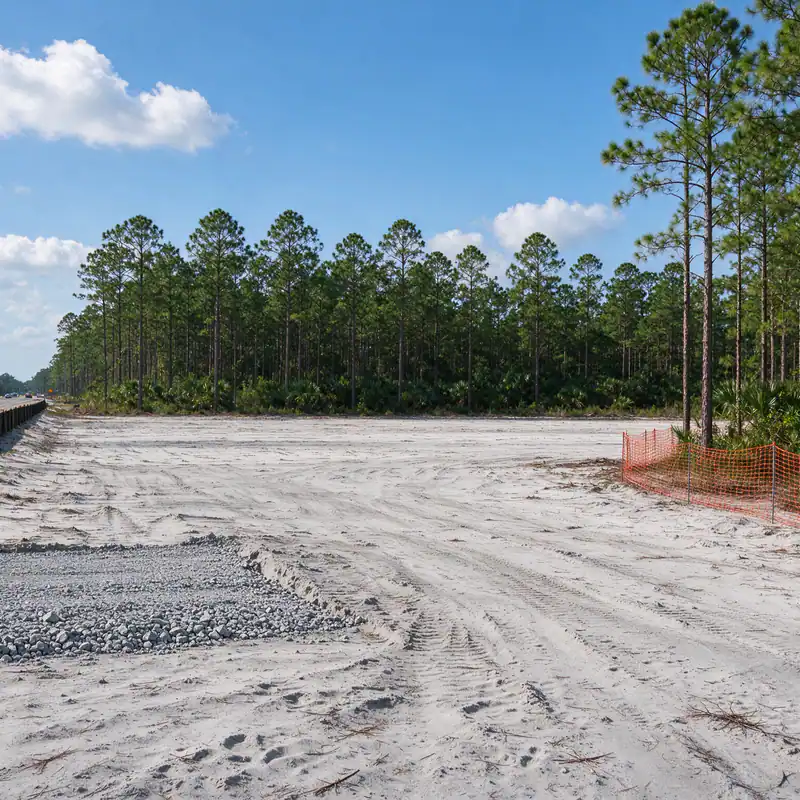
You have approved plans, a permit on the way and a site work contractor waiting to mobilize. Sunward Palm Coast Land Clearing clears commercial sites across Palm Coast and Flagler County for owners, developers and site work contractors, to the clearing limits, tree preservation areas and erosion control on your engineer’s sheets.
Commercial clearing differs from a home lot less in the machines than in the order of things. We work to a permit sequence and to the schedule of the site work that follows us.
When can clearing start?
In Palm Coast, once the site development permit is issued. The city requires that permit for all site work; you can apply once the development order is issued, and the building permit isn’t issued until the site development permit is. Clearing is site work, so it waits. On a home lot the trigger is the house permit instead, as our lot clearing page explains, and the city’s penalty schedule treats work started before a permit more harshly on commercial projects, scaling with the project’s value.
Outside the city, unincorporated Flagler County authorizes clearing through the development permit with a current tree survey, and the other cities in the area have their own processes, set out on each service area page.
How we build the scope from your plans
We read the clearing limits, preserved trees and areas, wetland lines and buffers, stormwater areas and the construction entrance off the sheets, then walk them on the ground against the surveyor’s stakes. Where the plans call for grubbing under buildings, paving and utilities, we mark it; where they show areas cleared but not grubbed, or left as natural buffer, we mark those too.
We also look for anything that changes the schedule: gopher tortoise burrows that need an FWC permit before work within 25 feet, ponded ground, overhead lines and truck access. Federally listed species have shaped clearing in Flagler County before, including a habitat conservation plan for the Florida scrub-jay and eastern indigo snake on a coastal development.
Plans approved?
Send us the clearing sheet and the permit status. We build the scope from the plans.
Erosion control and tree protection go in first
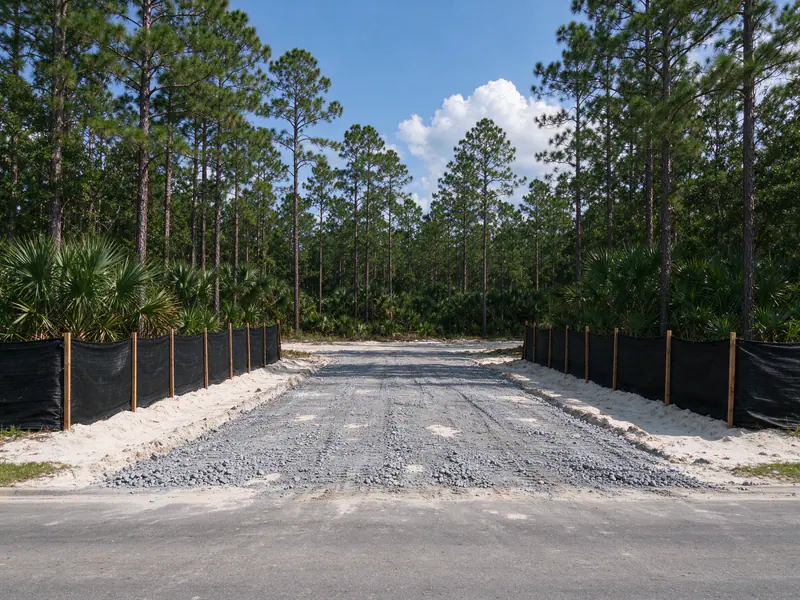
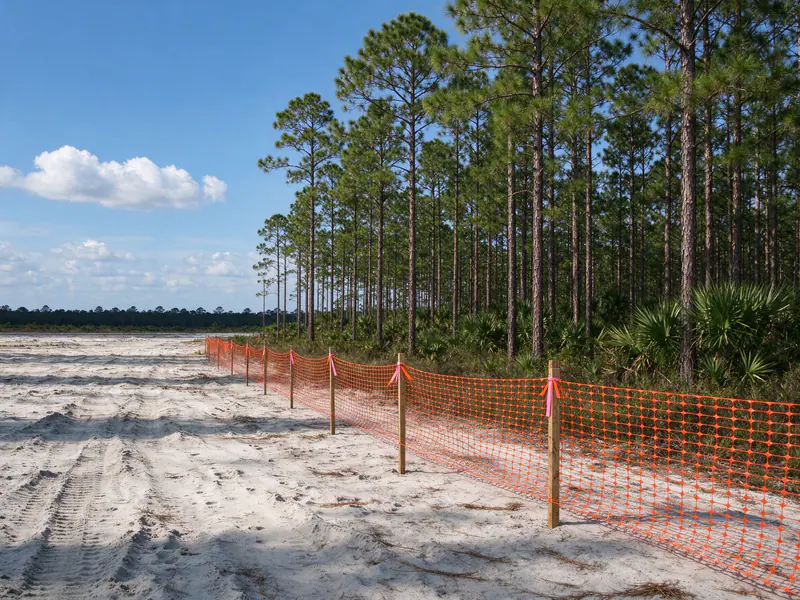
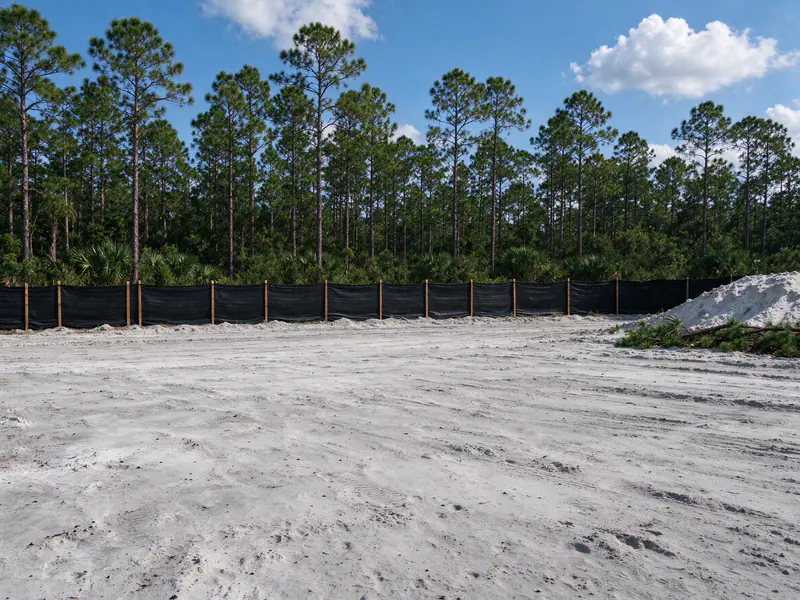
We install the silt fence and the construction entrance before any clearing, and they stay through construction. A commercial site opens far more bare ground than a home lot, and every storm tests the fence. At the same time we fence the preserved trees and areas, and nothing crosses that fence: no tracks, no stockpiles, no parking. Where the site borders a wetland, we flag the line set by the environmental resource permit and stop at it.
Clearing and grubbing to the plans
We clear the trees and brush inside the limits and grub where the plans call for it, usually under buildings, paving and utility corridors, down to clean soil. Areas shown for landscaping we may clear without grubbing. On a mixed site we may grub the building pad and parking, mulch the landscape strips and leave the buffers untouched, all in one mobilization. Our work ends where the earthwork begins: fill, compaction and grading belong to the site work contractor and the engineer’s plan, as our clearing or grading guide explains.
What about the trees on the plans?
Commercial tree removal in Palm Coast carries a $50 nonresidential tree removal fee in the city’s fee schedule, and replacement trees may be required, planted or paid into the tree bank at $220 to $580 per tree. Your approved landscape and tree preservation plans set what stays, and we follow them exactly, because a preserved tree taken by mistake gets replaced at the owner’s cost and can hold up inspections.
Wetlands and stormwater areas
Commercial sites often include or border wetlands, ponds or the low ground planned for stormwater. Florida sets wetland boundaries by plants, soils and hydrology, and construction or fill in a wetland can need an environmental resource permit from the St. Johns River Water Management District or the Florida DEP. Online maps only give a general idea; we clear to the permitted line on your plans.
Where does the debris go?
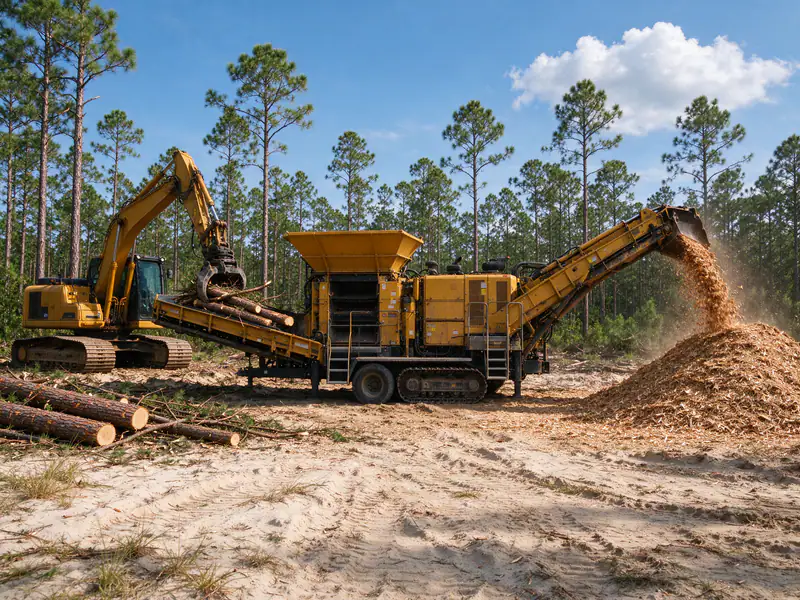
Commercial debris faces a stricter burning rule than a home lot. Florida keeps non-residential pile burns 1,000 feet from occupied buildings unless an air curtain incinerator is used, so on most commercial sites near Palm Coast we grind the wood on site or haul it. Disposal fees vary by county; in neighboring Volusia County the state’s table lists construction and demolition debris at $38.78 a ton. Our burning guide covers the rules.
Utilities, the road and the neighbors
Commercial sites often front busier roads, with overhead lines along the frontage and buried utilities in the right of way. We have buried lines located through 811 before any grubbing, plan felling and machine reach around the overhead lines, and bring trucks in only through the construction entrance so mud stays off the road.
When the site sits beside homes or a busy road, we fell toward the site, keep debris piles back from the road and the neighbors’ lines, and check the entrance and the silt fence after every heavy rain. We keep the bare ground between clearing and site work as small as the schedule allows.
Building in phases?
Then we clear only the area in the current phase’s permit. Leaving future phases wooded holds the soil, keeps the debris volume manageable and avoids ground sitting bare for a year or more. The phase lines on your plans become clearing limits on the ground, staked and flagged like any other boundary.
Schedule and cost
We schedule commercial clearing backward from the date your site work contractor mobilizes, so the clear finishes in time and the site isn’t bare for weeks. We price each commercial job from the plans: acreage, density, the grubbing area, erosion control and the debris route, and the estimate lists each line. Labor isn’t the expensive part here; equipment operators in the Deltona-Daytona Beach-Ormond Beach metro earn a mean $22.83 an hour against $31.87 nationally. Machine time, trucking and disposal carry most of the cost, as our cost guide shows for clearing generally.
What we do on a commercial site
- Clearing limits, preservation areas and wetland lines taken from the approved plans
- Erosion control installed and kept in place before clearing
- Tree protection fencing around preserved trees and areas
- Trees and brush cleared within the limits
- Grubbing where the engineer's plans call for it
- Debris ground, hauled or burned under an authorized method
- Site left ready for the site work contractor on the agreed date
Commercial and residential clearing in Palm Coast
| Commercial site | New home lot | |
|---|---|---|
| Permit that unlocks clearing | Site development permit, after the development order | The home's building permit |
| Plans | Engineered site plans with clearing limits | Survey with trees marked keep or remove |
| Debris burning | 1,000 ft setback without an air curtain incinerator | 300 ft from occupied homes |
| Schedule | Tied to the site work contractor | Tied to the builder |