Site development permit
Commercial land clearing
Clearing ahead of commercial site work once the site development permit is issued, with erosion control set and a tree plan that matches the approved plans.
Daytona Beach, Volusia County
Clearing a home lot or a commercial site in Daytona Beach? The city publishes its clearing and tree fees, so we put them in your estimate from day one and plan the debris around Volusia County's disposal costs.
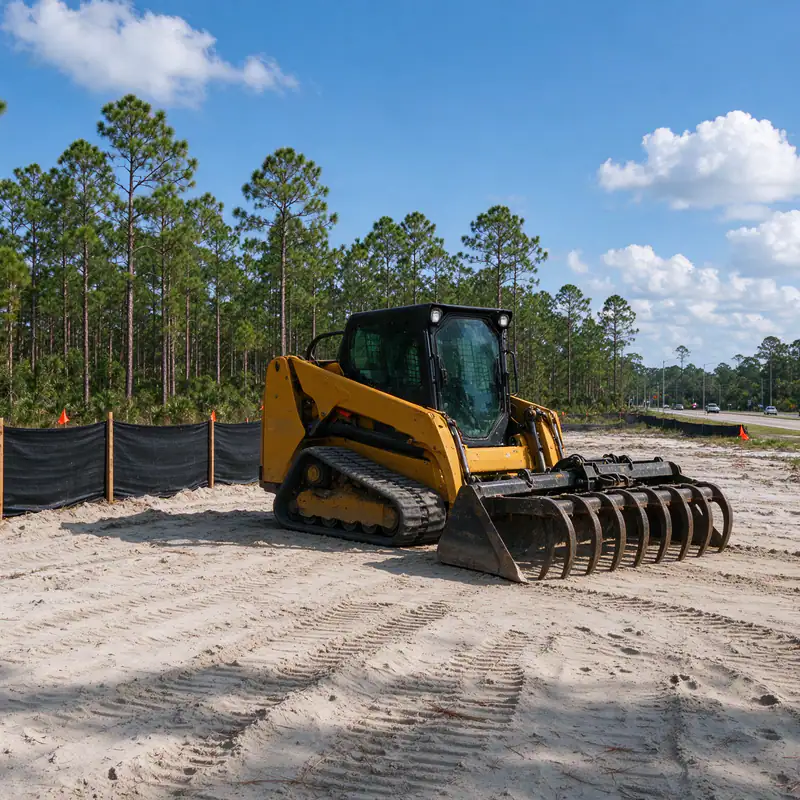
What changes a clearing job in Daytona Beach
Start with the land
Cleared to the approved plans once permits are in place, with erosion control first and debris ground or hauled.
Commercial land clearingThe city asks for two site plans and a tree permit form with any new structure or addition.
Lot clearingHistoric tree removal carries its own city fee, so planning around it usually comes first.
Selective clearingStumps ground below grade and brush cut back on lots that aren't being built on.
Stump grindingServices
Site development permit
Clearing ahead of commercial site work once the site development permit is issued, with erosion control set and a tree plan that matches the approved plans.
After the house permit
A platted lot opened for the slab, driveway and utilities once the home permit is issued, with the keepers marked, silt fence up and the swale left clean.
Roots out under the slab
Clearing takes what is above ground. Grubbing pulls the stumps, roots and buried organics out of the house footprint so the pad starts on clean sand.
Keeping the good trees
Brush and unwanted trees out around the oaks and pines you are keeping, with the keepers flagged before any machine arrives and the permit list in order.
Below grade
Stumps ground below grade in lawns, along driveways and in the yard, with a plain answer on when a stump has to come out whole instead.
Palmetto and underbrush
Saw palmetto, gallberry, wax myrtle and vines cut back to ground level, including the brush Palm Coast treats as a fire hazard beside a home.
How the work runs
We line up the clear and grade permit, plus the tree permit form and site plans where a structure is planned.
We count the trees coming out for the per-tree fee and spot any historic tree early.
Silt fence and entrance first, then clearing and grubbing to the plans, with your keepers fenced.
We grind on site where we can and haul the rest, with Volusia County disposal fees in your price.
Last Updated:
Daytona Beach is the biggest city we work in, about 26 miles south of Palm Coast, and it’s building at a pace to match: the Census Bureau counted 928 single-family homes permitted two years ago and 529 in the latest full year. Sunward Palm Coast Land Clearing clears home lots and commercial sites in Daytona Beach, and the city’s permit fees are some of the most clearly published in the area.
The city’s fee schedule lists a Clear and Grade Permit for land clearing only at $100. Tree removal or clearance is $20 per tree, capped at $600, and removing a historic tree is $175. The permits office asks for two site plans and a tree permit form whenever a new structure is built or an existing one is added to. We put those figures straight into your estimate: a lot with ten trees coming out carries $200 in tree fees, and one with thirty reaches the $600 cap. If the layout allows, we plan around a historic tree, because it carries its own fee and review; that’s where selective clearing pays for itself.
On commercial and multifamily sites we work to the approved plans: erosion control and the construction entrance first, clearing and grubbing to the staked limits, and the site handed over for grading, as our clearing or grading guide explains. Our commercial clearing page covers the sequence. On home lots the order is the same as anywhere: we sort the trees on the survey, fence the keepers and grub the footprint.
The ground at the city’s center is mapped as Electra fine sand, somewhat poorly drained. It’s workable most of the year, but the summer rains soften it, so we get silt fence on bare ground before the storms. Low, ponded areas can raise the wetland question, where a state permit can apply before clearing.
Vacant lots with dry, sandy ground are where gopher tortoises dig, even inside a city. Any work within 25 feet of a burrow needs an FWC relocation permit, so we look for burrows on the walk instead of finding them with the machine; our gopher tortoise guide covers the rule. We fence the trees you’re keeping at the drip line before clearing, and grind the stumps near them instead of pulling them.
Burning isn’t realistic inside the city: Florida keeps residential pile burns 300 feet from occupied buildings and non-residential burns 1,000 feet without an air curtain incinerator, as our burning guide explains. Volusia County lists yard trash at $31.44 a ton and construction and demolition debris at $38.78 in the state’s disposal fee table, so grinding brush on site where it can stay often saves you money over hauling it all. The clearing itself follows our typical ranges in the land clearing cost guide.
Why the order matters
The city publishes a flat clear and grade fee and a capped per-tree fee, so we put both in your estimate from day one.
A historic tree has its own removal fee and review, so we plan the site around it if we can.
Volusia County's yard trash rate in the state's table makes grinding on site worth considering.
Places, routes and the permit office
City of Daytona Beach Permits and Licensing: clear and grade permit, tree removal, and the tree permit form filed with site plans for new structures.
The city's published fee schedule lists a Clear and Grade Permit for land clearing only at $100, with tree removal or clearance at $20 per tree up to $600 and historic tree removal at $175.
The city asks for two site plans and a tree permit form when building a new structure or adding on to an existing one.
Our typical range for clearing a quarter-acre lot is $800 to $3,000, and acreage runs $1,200 to $8,000 per acre by density. City permit fees and Volusia County disposal, $31.44 a ton for yard trash, are separate.
Rarely. Residential piles need 300 feet from occupied buildings, and non-residential burning without an air curtain incinerator needs 1,000 feet, which city sites can't meet. Debris is ground or hauled.
A soil survey sample at the city's center point finds Electra fine sand, somewhat poorly drained, so summer rain slows machines and bare ground needs silt fence.
Get a Daytona Beach clearing estimate
Send the site address, the plans or survey, and the permit status.
(386) 465-4658Outside these hours, emergency calls only.