Keeping the good trees
Selective clearing
Brush and unwanted trees out around the oaks and pines you are keeping, with the keepers flagged before any machine arrives and the permit list in order.
St. Augustine Shores, St. Johns County
Building on a wooded lot in St. Augustine Shores? The county counts tree inches, so every oak you keep saves planting later. We measure your keepers, take out the invasives first and clear the house site around the rest.
What changes a clearing job in St. Augustine Shores
Start with the land
The county's tree-inch minimum is met by keeping existing trees, planting new ones, or both.
Lot clearingExisting trees of 2 inches and up may count, so keepers lower the planting bill.
Selective clearingCamphor, Chinaberry, tallow, Brazilian pepper and other exempt species don't count and can come out.
Brush clearingServices
Keeping the good trees
Brush and unwanted trees out around the oaks and pines you are keeping, with the keepers flagged before any machine arrives and the permit list in order.
After the house permit
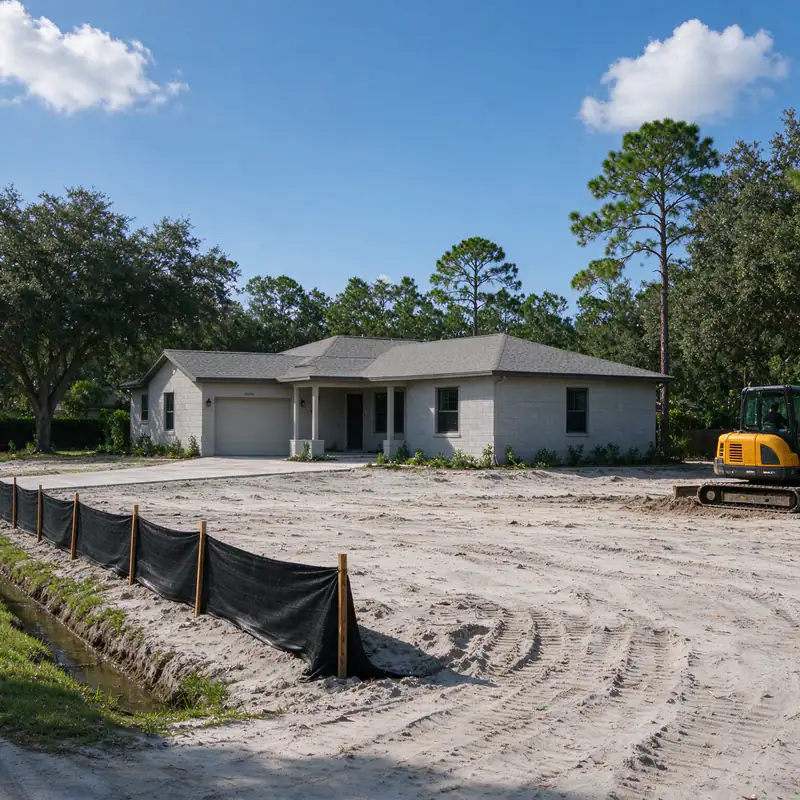
A platted lot opened for the slab, driveway and utilities once the home permit is issued, with the keepers marked, silt fence up and the swale left clean.
Below grade
Stumps ground below grade in lawns, along driveways and in the yard, with a plain answer on when a stump has to come out whole instead.
Palmetto and underbrush
Saw palmetto, gallberry, wax myrtle and vines cut back to ground level, including the brush Palm Coast treats as a fire hazard beside a home.
How the work runs
We check the tree-inch minimum for your zoning and any specimen trees the site plan has to show.
We measure the trees of 2 inches and up outside easements and wetlands and add up what they cover.
We remove the invasives and the trees in the footprint, fence the keepers and grub the footprint.
We haul the debris and leave the lot ready for your builder and any required planting.
Last Updated:
St. Augustine Shores is an unincorporated community south of St. Augustine along US 1, about 19 miles north of Palm Coast. Because it sits outside any city, St. Johns County’s rules apply, not the City of St. Augustine’s 3-inch permit. Sunward Palm Coast Land Clearing clears lots and handles tree and stump work here, and the county’s tree count shapes every plan we write.
Because your site plan has to meet a minimum number of tree inches set by your lot’s zoning, if the lot isn’t already covered by an approved neighborhood site plan. Existing trees of 2 inches and up, measured at 4.5 feet, can count toward it, and specimen trees have to be shown on the plan. Anything short of the minimum gets made up by planting, and the new trees must be at least 70% canopy trees and at least 50% native.
So the keep list is arithmetic. Every healthy oak or pine we keep outside the footprint adds inches; every one that comes down may have to be replaced. We measure each candidate at 4.5 feet and add it up before clearing, so you know how much planting, if any, the site plan will need.
Trees in easements and wetlands don’t count either way, and neither do the exempt species: camphor, Chinaberry, tallow, Brazilian pepper, mimosa, Australian pine, and queen and Washington palms. Those are the first trees we take down. Then we clear the footprint the way we handle selective clearing: keepers flagged and fenced at the drip line, the house site cleared and grubbed, and stumps near keepers ground below grade instead of pulled, so we don’t tear the roots of the trees you’re counting on.
Usually, yes. Much of the community sits on moderately well drained fine sand that stays firm through more of the summer than the wet flatwoods farther south, so rain holds us up less here. Dry sand is also gopher tortoise ground, so we walk your lot for burrows first, and work within 25 feet of one needs an FWC permit.
We haul the debris, since a pile burn can’t meet Florida’s 300-foot residential setback on a residential street, and the haul is part of the price. Under the slab, stumps and roots come out with the topsoil, the same as any lot clearing job.
The address, the site plan or survey if you have one, and photos of the trees you’d like to keep. Our guide to what clearing includes helps you compare estimates line by line, and our grind or remove guide explains which stumps come out and which get ground.
Why the order matters
Every tree we keep that qualifies cuts what you'd have to plant to meet the county minimum.
Exempt species count for nothing, so we take them out first.
Places, routes and the permit office
St. Johns County Growth Management: residential site plans and the minimum tree-inch requirement for unincorporated lots.
Residential site plans for lots outside an approved neighborhood site plan must meet a minimum number of tree inches set by zoning. Existing trees of 2 inches and up, measured at 4.5 feet, may count, and specimen trees must be shown on the site plan.
Trees in easements or wetlands don't count, and exempt species such as camphor, Chinaberry, tallow, Brazilian pepper, mimosa, Australian pine and queen and Washington palms don't either.
Our typical range for a quarter-acre lot is $800 to $3,000, set after we walk the lot. Any trees you plant to meet the county's tree-inch minimum are a separate cost, and keeping existing trees reduces it.
No. St. Augustine Shores is unincorporated, so St. Johns County's rules apply instead of the city's 3-inch permit.
A soil survey sample at the community's center point finds Tavares fine sand, moderately well drained, which stays workable through more of the rainy season than wet flatwoods.
Get a St. Augustine Shores clearing estimate
Send the address, the site plan or survey, and photos of the trees you want to keep.
(386) 465-4658Outside these hours, emergency calls only.