Keeping the good trees
Selective clearing
Brush and unwanted trees out around the oaks and pines you are keeping, with the keepers flagged before any machine arrives and the permit list in order.
St. Augustine, St. Johns County
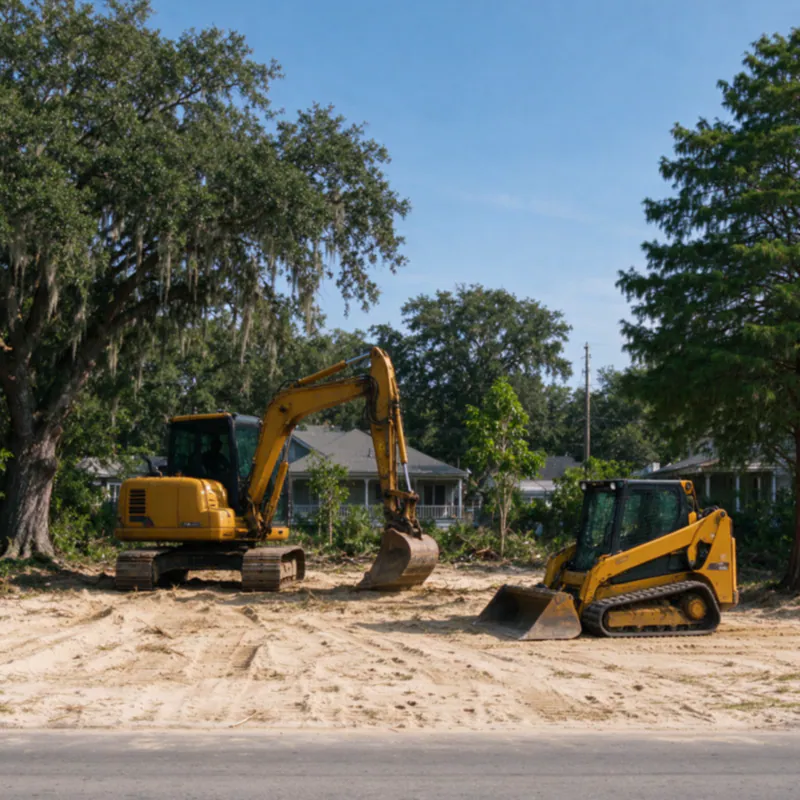
Building on a small St. Augustine lot, or opening up a yard under the oaks? Here almost every tree needs a permit and costs two back, so we plan your clearing around the trees that can stay.
What changes a clearing job in St. Augustine
Start with the land
New construction needs a tree survey of every tree with its type and size, so the keep list starts there.
Lot clearingA southern red cedar over 2 feet tall or 1 inch across at 3 inches above ground needs a permit.
Selective clearingEven a 3-inch tree needs the $30 permit; the stump is ground afterward.
Stump grindingBrush and vines cut back without removing any tree that needs a permit.
Brush clearingServices
Keeping the good trees
Brush and unwanted trees out around the oaks and pines you are keeping, with the keepers flagged before any machine arrives and the permit list in order.
After the house permit
A platted lot opened for the slab, driveway and utilities once the home permit is issued, with the keepers marked, silt fence up and the swale left clean.
Below grade
Stumps ground below grade in lawns, along driveways and in the yard, with a plain answer on when a stump has to come out whole instead.
Palmetto and underbrush
Saw palmetto, gallberry, wax myrtle and vines cut back to ground level, including the brush Palm Coast treats as a fire hazard beside a home.
Roots out under the slab
Clearing takes what is above ground. Grubbing pulls the stumps, roots and buried organics out of the house footprint so the pad starts on clean sand.
Site development permit
Clearing ahead of commercial site work once the site development permit is issued, with erosion control set and a tree plan that matches the approved plans.
How the work runs
We list every tree by type and size, as the city asks for on new construction, including the small red cedars.
We plan the $30 permit for each removal and the replacement at two trees for one, or $300 each to the fund.
Small lots and close neighbors, so we work mostly by saw and small machine, with your keepers fenced.
We pull the stumps under the footprint, grind them elsewhere, haul the debris and walk the lot with you at the end.
Last Updated:
St. Augustine, about 25 miles north of Palm Coast and the St. Johns County seat, is a city of small, close-built lots, and its tree permit starts at half the trunk size Palm Coast’s does. The Census Bureau counted 71 single-family homes permitted in the city in the latest full year. Sunward Palm Coast Land Clearing clears lots, brush and stumps in St. Augustine, and nearly every job we do there starts with the tree permit.
The city’s code makes it unlawful to cut down, destroy or remove any tree 3 inches or larger in diameter at breast height without a permit, half of Palm Coast’s 6-inch threshold. The permit costs $30 from the city’s Planning and Building office. Southern red cedar gets its own rule: one over 2 feet tall, or 1 inch in diameter measured 3 inches above the ground, needs a permit too. For new construction the city asks for a tree survey showing every tree with its type and size. On a wooded city lot that survey becomes our plan for selective clearing, because at those thresholds almost everything with a trunk counts.
Replacement is where the cost lies. Each tree removed with approval of the Planning and Zoning Board or the Code Enforcement, Adjustment and Appeals Board has to be replaced with two similar trees on site, or, where replanting on site isn’t feasible, $300 per required replacement tree goes to the city’s Tree Mitigation Fund. Removing four trees can mean planting eight or paying $2,400, before any clearing work is priced. So we look hard for the trees that can stay: set back from the footprint, healthy and long-lived, fenced at the drip line while we open the house site.
The ground at the city’s center is mapped as St. Augustine-Urban land complex, a somewhat poorly drained made land, and lots have neighbors on every side. Access, not acreage, sets our method: saws, small machines and careful felling into the lot instead of a big mulcher. Burning is ruled out by Florida’s 300-foot residential setback, so we haul the wood. Under the house footprint we pull the stumps with their roots; elsewhere we grind them below grade, as our grind or remove guide explains.
St. Augustine’s rules apply inside city limits. The unincorporated communities nearby, such as St. Augustine Shores and St. Augustine South, follow St. Johns County’s tree-inch rules instead, and St. Augustine Beach is its own city with its own fees. Our clearing prices follow the typical ranges in the land clearing cost guide; the permits and mitigation sit on top.
Why the order matters
At 3 inches, far more trees need a permit than in Palm Coast, so we build the plan on your survey.
Two trees back for each one removed, or $300 per tree, makes keeping trees the economical choice.
Tight access decides our method more than the size of your lot does.
Places, routes and the permit office
City of St. Augustine Planning and Building: tree removal permits for trees 3 inches DBH and larger.
Any tree 3 inches or larger in diameter at breast height. Southern red cedars need one from just over 2 feet tall or 1 inch in diameter at 3 inches above the ground. The permit costs $30 from Planning and Building.
A tree removed with board approval is replaced by two similar trees on site, or $300 per required replacement tree is paid into the Tree Mitigation Fund when replanting on site isn't feasible.
The clearing itself follows our typical ranges across the area, about $800 to $3,000 for a quarter-acre lot. The city's $30 permit per tree and any mitigation at two-for-one or $300 per replacement tree are separate and can add up.
Yes. The city requires a tree survey showing all trees with their type and size for new construction.
No. The city has its own permit and mitigation rules. Unincorporated areas such as St. Augustine Shores and St. Augustine South follow the county's tree-inch requirements instead.
Get a St. Augustine clearing estimate
Send the address, the tree survey if you have one, and photos of the trees you want to keep.
(386) 465-4658Outside these hours, emergency calls only.